


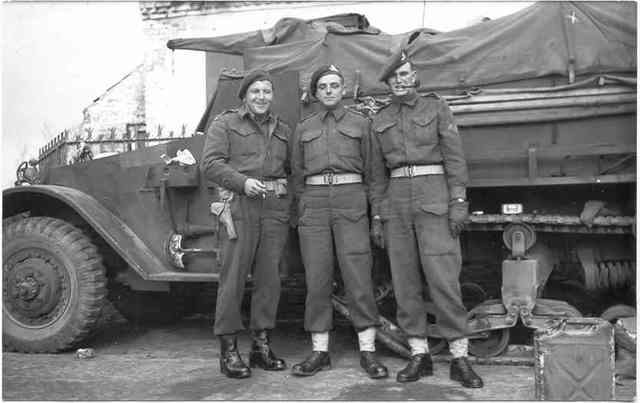
Holland: Dog Troop, 71st Battery which is Q(ueen) Battery.
They were not allowed to use the battery number for security reasons so
used "Q"
Left to right: Lt. Macysmic, troop leader, John Fearnley, Bombardier, Troop Command Post Senior ACK, Sgt. Alec Watts Troop Signal Officer
My name is John Fearnley and I am a veteran of the Italian Campaign. I remember when I first met my friend Stan Farrow when he was posted to the 8th Field Regiment after finishing an officer's course. I had just completed a gun position officer's assistant course, and I was in O Troop. We had been in action in a static position near Ortona during the winter. We were taken out and given some hard training, and then we were sent to Cassino. I remember seeing a sign on the side of the road that read, "If you don't speak good German, don't go any further." We first laid down an artillery barrage, and I could see the ambulances coming down the road about fifty yards apart. The advance party left soon after the barrage, and we got word that the advance party had all been killed. (There were nine men in the advance party, one survived but never came back to the regiment.)
The gun position officer assistant with us got wounded and was taken to the hospital. The small plane that was directing the barrage went to have dinner and gas – up, but got too low and collided with one of the artillery shells (they use men who are colour blind on that job.)
They took the other officer with them which left Stan and I alone. We lost the half-track with the best of our equipment in it. We moved forward that night with the scout car- all we had left were two signallers, a driver, Stan and I. The guns were following up. The advance party were to have a place ready to put the guns but they never got there. Stan and I had to do it ourselves. We got the guns in and fired a lot of rounds that day. I got a slit trench dug, and the observation post captain relieved us that night to let us get some sleep. They began to drop flares and bombs that night, and I crawled under my blanket and buried my face in the dirt. Stan and the signallers were lying in an irrigation ditch.
I went out the next morning with the advance party and left Stan to bring up the guns, and he got hung up at the Melfa River at the Bailey Bridge. We had trouble getting a rear guard sniper. They shelled Stan at the bridge over the Melfa River and our MP guard on the bridge got wounded and was hauled out in an ambulance. I could hear Stan on the radio wanting to know what the hold was, wanting to get out of the Melfa . We were up working to get the gun positions ready for the guns where the Strathcona Horse had lost about 70% of the tanks the day before, and the tanks were sitting about 50 yards apart still burning, with burned bodies strewn beside them. It was an awful sight.
We got a new half-track and a new driver. His name was Pat Hilker. Pat
got to be the cook for us when we were on the move. He would pick up some
hens and carry them in cages on the front of the half-track. They either
laid eggs for us to eat, or we ate them. Pat would run them out in the
mosquito netting during the day when we were in position. Sometimes the
hens would get out from the netting and we would have to chase them through
the grape vines and olive groves. And no, chickens don’t eat olives.
I got a two day pass on the day the war ended. I was in Comines, Belgium
and on the day the war ended I led a parade in church. That was a great
celebration!
In closing I would like to say that for the past ten years or so, Stan and I have kept in touch via the telephone. It has meant a lot to me. I am happy to say I have also been in touch with Pat Hilker. A lot of memories!
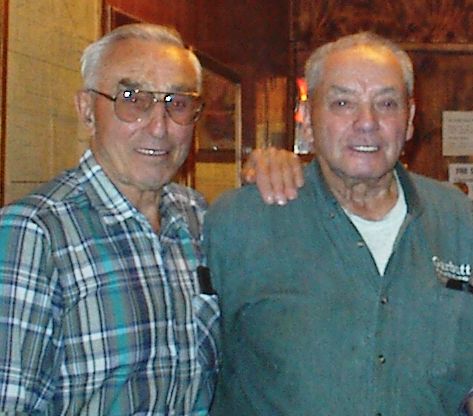
Old friends and comrades- Stan and John
